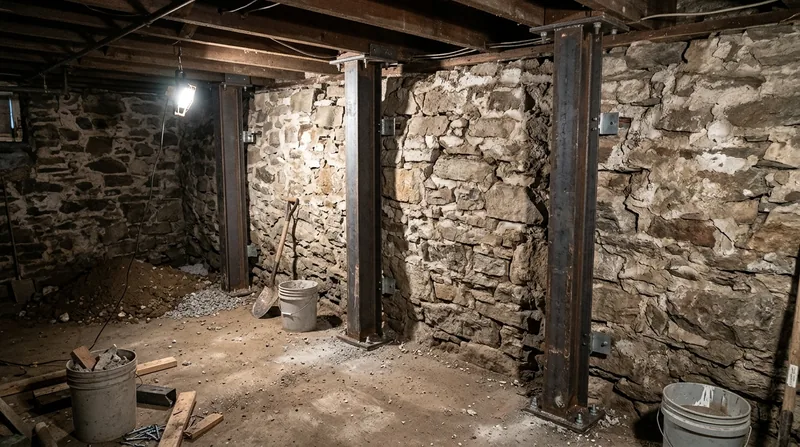




Bowing Wall Repair in Danbury: Stabilize the Wall Before the Next Thaw
When a basement wall starts to lean, the cause is almost always outside the house. In Danbury, the ground is glacial till over granite and schist ledge, and shallow bedrock pushes groundwater up at the footing after every heavy rain. Hillside lots in Padanaram and the slopes above the Still River shed runoff straight toward the foundation, and the freeze-thaw cycle works on old fieldstone and early block walls until they bow inward. Bowing Wall Repair in Danbury means reading that pressure correctly and choosing the right method to stop the movement, not just patching the crack you can see. We handle the structural side below grade and the water that drives it, from carbon fiber straps to steel I-beams and wall anchors. If the wall is moving, call (475) 256-1959 and we will look at it before the spring thaw loosens the soil further. For the water side of the same problem, see our basement waterproofing service.
Why Bowing Walls Show Up So Often in Danbury's Older Neighborhoods
Downtown Danbury and the mill-era streets are full of 1900s to 1940s houses with fieldstone, brick, or early block cellars. Those walls were built to hold back soil, not to resist hydrostatic pressure from a rising water table. When the Still River and its brooks flood fast after a winter storm, saturated glacial clay soil pushes hard against the wall, and the freeze-thaw cycle cracks the mortar and opens joints. On the 1950s to 1970s raised ranches and split-levels in Padanaram, the same pressure shows up as a horizontal crack at mid-wall and a lean at the top.
- Horizontal cracks in a block or poured wall signal pressure, not settling.
- A wall that leans inward more than an inch over its height needs evaluation now.
- White powder (efflorescence) on the wall means water is moving through the concrete.
- Doors and windows that stick on one side of the basement often follow wall movement.
- Fieldstone walls with pushed-out mortar joints are common after a hard Danbury winter.
Any one of these signs is a reason to get the wall looked at before the next wet season adds more load.
Key info: On a 1920s brick cellar wall off Main Street in Danbury, a horizontal crack at mid-height and a two-inch lean at the top pointed to soil pressure from a hillside lot, not a settling foundation. Carbon fiber straps and corrected grading stopped the movement without excavating the whole wall.
Permits for structural foundation repair are commonly required in Connecticut, and thresholds vary by jurisdiction. Always verify with the Danbury Building Department before work begins. The state contractor registration lookup at CT.gov DCP lets you confirm a contractor's credentials.
How We Diagnose and Repair a Bowing Wall in Danbury
We start by finding out what is pushing the wall and how far it has moved. That means checking the soil side, the water table, the footing drain, and the wall itself. A wall that is wet and bowing needs the water managed as well as the structure braced, or the repair will not hold. We match the method to the severity of the movement and the pressure of wet soil on a hillside.
- We inspect the wall for crack direction, lean, and signs of active movement.
- We check grading, downspout extensions, and window well drainage on the uphill side.
- We confirm whether hydrostatic pressure or a failing drain tile is feeding the problem.
- We recommend carbon fiber straps, steel I-beams, or wall anchors based on the load.
- We correct the water source with drainage or sealing so the repair is not fighting a wet wall.
- We document the before and after so you can see the wall is stable.
The right fix depends on whether the wall is cracked, leaning, or both, and we say plainly when simple crack sealing is enough and when the real problem is pressure.
Key info: A raised ranch in Brookfield had a poured wall bowing at the top after years of runoff from an uphill driveway. Wall anchors pulled it back to plumb, and a french drain installation on the uphill side cut the water reaching the footing.
If the wall is cracked but not moving, foundation crack repair with epoxy or polyurethane injection may be all you need. If the wall is bowing, the structure has to be addressed first.
Comparing Bowing Wall Repair Methods
Not every bowing wall needs the same repair. The table below shows the main approaches we use in Danbury and the conditions each one fits. We choose based on wall material, the amount of movement, and how much water is loading the soil behind it.
| Approach | Description | Best for |
|---|---|---|
| Carbon fiber straps | Straps bonded to the wall resist inward movement without excavation. | Moderate bowing in block or poured walls. |
| Steel I-beams | Vertical beams anchored floor to joist hold the wall in place. | Heavier movement or long walls under pressure. |
| Wall anchors | Anchors in stable soil outside pull the wall back toward plumb. | Walls that have leaned but are still sound. |
| Epoxy injection | Ports inject epoxy into cracks to restore the wall's strength. | Cracked poured walls with little movement. |
| Drainage correction | Grading, downspout extensions, and drain tile relieve pressure. | Any bowing wall fed by hillside runoff. |
The repair only holds when the water that caused the pressure is managed too, so we treat the two as one job.
Bowing Wall Repair Cost in Danbury: What to Expect
Most bowing wall repairs we do in Danbury start around $600 for a focused crack injection or a small strap job, and climb from there. The price depends on how far the wall has moved, the wall material, and how much drainage work is needed to stop the pressure. A fieldstone cellar in an old mill-era house costs more to stabilize than a poured wall in a 1990s colonial in Newtown. We give a written scope before any work starts.
Factors that move the number: the number of straps or beams, whether wall anchors are needed, whether the footing drain has to be repaired, and access to the wall. Getting two or three estimates is smart so you can compare scope, not just price. Our full pricing overview shows how each piece is priced.
What to Look For When Hiring a Bowing Wall Repair Contractor Near Danbury
Bowing wall repair is structural work, so the contractor matters as much as the method. Ask for proof of licensing and insurance, and get a certificate of insurance before work starts. Get at least two or three written estimates that describe the same scope so you can compare fairly. Ask for local references on jobs like yours, especially older fieldstone or block walls. Confirm who pulls the permit, since structural foundation repair commonly requires one in Connecticut, and verify the rules with the Danbury Building Department. If your neighborhood has HOA requirements, check them before scheduling.
Reach us through our contact page or call (475) 256-1959 to set up a look at your wall.
Bowing Wall Repair in Danbury: Pricing Guide
| Service | Price | Details |
|---|---|---|
| Crack injection (epoxy or polyurethane) | Starting at $600 | Covers a focused injection on a cracked poured wall with little movement, ports included. |
| Carbon fiber strap repair | Starting at $1,200 | Straps bonded to a bowing block or poured wall, priced by the number of straps needed. |
| Steel I-beam or wall anchor system | On estimate | Heavier movement or long walls need an on-site look to size the beams and anchors. |
| Drainage correction with the repair | On estimate | Grading, downspout extensions, or drain tile work priced after we trace the water source. |
| Travel | Included | In Danbury and surrounding areas, no separate call-out or mileage fee. |
| Estimate | Free | Response within 24h at (475) 256-1959, no obligation to book. |
Indicative pricing, the exact cost depends on square footage, finish, and site access. Free personalized estimate within 24h at (475) 256-1959.


