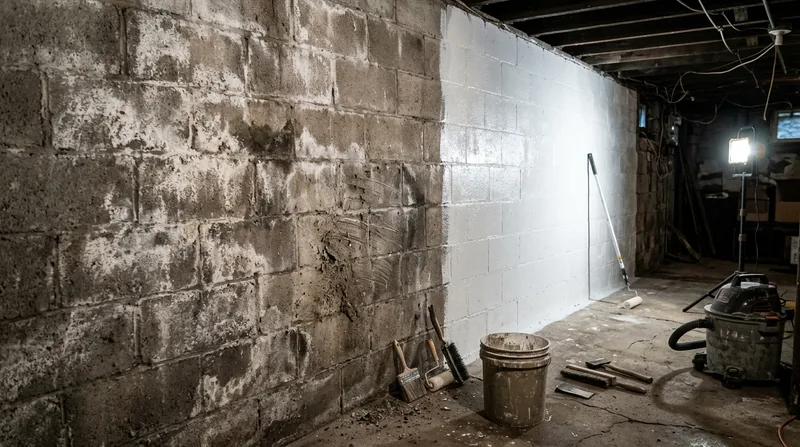




Danbury sits on glacial till over granite and schist ledge, and that shallow bedrock pushes groundwater up at the footing every time the Still River and its brooks rise after a heavy rain. In the mill-era streets off Downtown Danbury, fieldstone and early block cellars wick moisture through mortar joints all winter, while the 1950s and 1960s raised ranches in Padanaram sweat at the cove joint from freeze-thaw movement. Basement Wall Sealing in Danbury starts with an honest diagnosis: if your wall is damp and chalky with efflorescence but no water is pushing in, a penetrating sealer or membrane will handle it, and if hydrostatic pressure is driving water through the block, no coating on earth will hold it back. We prep the surface, remove the efflorescence, and tell you plainly which problem you actually have before we sell you anything. Start with a free basement inspection and we will map the seepage source wall by wall.
Why Basement Wall Sealing Matters on Danbury's Ledge and Hillside Lots
Danbury's ground is glacial clay soil packed over shallow ledge, and on the slopes above the Still River the runoff sheds straight toward the house instead of soaking away. When the water table climbs in spring thaw, it finds every cold joint, tie hole, and hairline crack in a poured wall, and it eats the mortar in an old fieldstone cellar until the wall goes soft. Sealing is the right first move for surface dampness and vapor drive; it is the wrong move when water is standing against the footing.
- We remove efflorescence and loose parging before any sealer touches the wall, because a coating over salt bloom will blister within a season.
- We test for active hydrostatic pressure so we do not seal a wall that needs drainage behind it.
- We seal the cove joint, tie holes, and hairline shrinkage cracks that let vapor and seepage through poured foundations.
- We flag bowing walls and step cracking for structural review instead of hiding them under a membrane.
If the wall is damp but dry to the touch between storms, sealing is usually the whole job, and we will say so.
Key info: A 1920s brick cellar on a mill-era street near Downtown Danbury often shows white efflorescence and a musty basement smell but no standing water. That is vapor and capillary dampness, and a breathable penetrating sealer plus corrected grading and downspout extensions usually solves it. A 1990s colonial in Newtown with water fanning across the floor after every storm is a different animal: that is the water table at the footing, and it needs an interior perimeter drain, not a coating.
Connecticut homeowners can verify contractor registration through the Department of Consumer Protection before signing anything, and we encourage you to do exactly that.
How We Seal a Danbury Basement Wall, Step by Step
Every job starts below grade with a moisture reading and a look at the footing, the drain tile, and the grading outside. We do not quote a sealer until we know whether the wall is damp from vapor or wet from pressure, because the two problems take different fixes and only one of them is a sealing job. Here is how a straight sealing project runs on a typical Danbury wall.
- We inspect the wall, the cove joint, and the exterior grade, and we check the sump basin and discharge line if one is present.
- We wire-brush and scrape the wall to remove efflorescence, old paint, and failing parging so the sealer bonds to sound masonry.
- We fill tie holes and hairline cracks with hydraulic cement or epoxy injection where the crack is active and structural.
- We apply the penetrating sealer or the membrane system in the coverage the manufacturer specifies, not a thin cosmetic coat.
- We correct grading and downspout extensions at the same visit, because sealing a wall while roof water still dumps at the foundation is wasted money.
- We walk the wall with you at the end and explain what to watch for over the next wet season.
When the inspection shows pressure rather than dampness, we route you to an interior drain tile system instead of selling a sealer that will fail.
Key info: On a raised ranch in Padanaram, we found the rear wall wet only at the bottom two courses after rain, with the cove joint dry. The culprit was a downspout dumping at the corner and grade sloping back to the house. We re-graded, extended the downspout, sealed the lower block, and the wall stayed dry through the next spring thaw. No excavation, no drain tile, and we told the homeowner that up front.
Sealing Approaches We Use on Danbury Basement Walls
Not every damp wall takes the same product, and the choice depends on the masonry, the moisture source, and whether the wall is painted, parged, or bare. This table shows how we match the approach to the wall you actually have.
| Approach | Description | Best for |
|---|---|---|
| Penetrating sealer | Soaks into the masonry and reacts with free lime to block capillary vapor drive without trapping moisture. | Damp, chalky block and poured walls with efflorescence but no pressure. |
| Cementitious membrane | Troweled or brushed coating that bridges small voids and seals rough fieldstone and early block. | Old mill-era fieldstone and brick cellars with uneven mortar joints. |
| Epoxy injection | Ports drilled along a crack and filled under pressure to bond the two sides back together. | Structural, non-moving cracks in poured walls that need stiffness, not just a seal. |
| Polyurethane injection | Flexible foam that expands and stays elastic inside an active, moving leak. | Active seepage at cold joints and tie holes where the crack will move again. |
| Cove joint and tie hole sealing | Hydraulic cement and polyurethane at the wall-floor junction and form tie holes. | Water entering at the base of a poured wall with no wall-face seepage. |
We choose the product after the moisture reading, not before, and we tell you when a $900 sealing job is the answer and when it is not.
Basement Wall Sealing Cost in Danbury: What to Expect
Most residential wall sealing jobs in the Danbury area start around From $1,500, and that figure covers a typical single-wall or partial-perimeter job with surface prep, efflorescence removal, and a quality sealer. The number moves with wall length, masonry type, and how much prep the wall needs. A rough fieldstone cellar in Downtown Danbury takes far more labor than a smooth poured wall in a Brookfield colonial, and a wall that needs crack injection first adds to the total.
Factors that move the price: the square footage of wall face, whether the wall is painted or parged (both must come off), whether active cracks need epoxy or polyurethane injection, and whether we are also correcting grading and downspouts. Access matters too, since a finished basement means moving stored goods and protecting the floor before we start. We quote the sealing work and the drainage correction separately so you can see what each dollar buys. For a fuller breakdown of what drives the number, see our pricing overview.
Get two or three estimates and compare scope, not just the bottom line. A quote that skips surface prep or sells a sealer for an active pressure leak is not a cheaper job, it is a job you will pay for twice.
Choosing a Basement Wall Sealing Contractor Near Danbury
Basement wall sealing is one of those jobs where the prep work matters more than the product label, so hire for method and honesty, not for the lowest number on a flyer. Ask any contractor near Danbury how they handle efflorescence, what they do when they find hydrostatic pressure, and whether they will tell you to skip the sealer when drainage is the real fix. A specialist who works below grade every day will answer those questions straight.
- Confirm the contractor is licensed and insured and ask for the certificate, not just a verbal assurance.
- Get two or three written estimates that spell out surface prep, product, and warranty terms.
- Ask for local references on jobs like yours, especially old fieldstone or brick cellars.
- Ask whether a permit is required for any structural crack injection or drainage change, and verify with the Danbury building department.
- Read the warranty and confirm it is transferable, and get the coverage terms in writing.
When you are ready to talk through your wall, reach out through our contact page and we will set up a free inspection.
Key info: A homeowner in Ridgefield got three quotes for a wet block wall. Two proposed a sealer only. The third found water pushing at the cove joint and recommended an interior perimeter drain with a sump basin, which was the correct fix. The cheapest quote would have failed within one wet season. That is why we push for a real inspection before any sealer is sold.
If you are searching for basement wall sealing near me in the Danbury area, call (475) 256-1959 and we will tell you what your wall needs, even when the answer is not a sealing job.
Basement Wall Sealing in Danbury: Pricing Guide
| Service | Price | Details |
|---|---|---|
| Single wall sealing, poured concrete | Starting at $1,500 | Includes surface prep, efflorescence removal, and penetrating sealer on one typical wall. |
| Fieldstone or brick cellar wall | Starting at $2,200 | More labor for mortar joint prep and cementitious membrane on rough old masonry. |
| Crack injection add-on | Starting at $450 | Epoxy or polyurethane injection with ports, priced per active crack length. |
| Full perimeter sealing | On estimate | Wall length, access, and finished basement protection all move the number, so we look first. |
| Travel | Included | in Danbury and surrounding towns, no separate call-out or mileage fee. |
| Estimate | Free | Response within 24h at (475) 256-1959, no obligation to book. |
Indicative pricing, the exact cost depends on square footage, finish, and site access. Free personalized estimate within 24h at (475) 256-1959.


