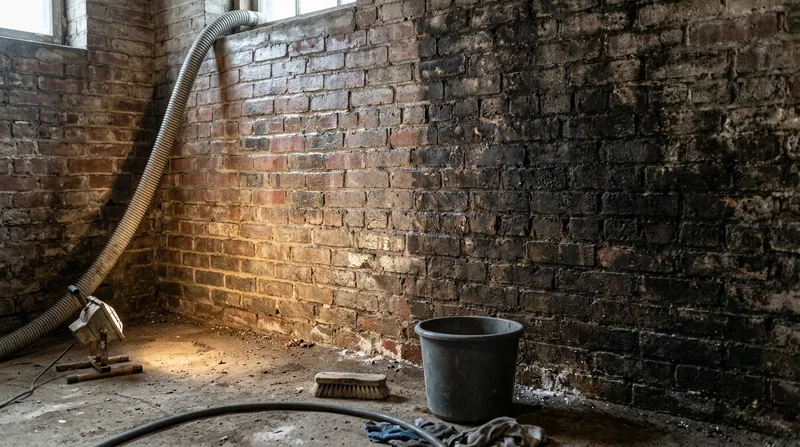




Basement Mold Remediation in Danbury: Fix the Moisture, Not Just the Mold
Basement Mold Remediation in Danbury starts with one honest question: where is the water coming from? This city sits on glacial till over granite and schist ledge, and that shallow bedrock pushes groundwater up at the footing after every long rain. Add the Still River and its brooks, which rise fast after a spring thaw or a winter storm, and you get the pattern we see across Downtown Danbury and the mill-era streets: fieldstone and early block cellars that seep at the joints, then grow mold on the joists and the bottom of the stairs. We treat the affected surfaces and then fix the moisture source, so the growth does not come back next season. If you want the full picture of how we keep water out, start with our basement waterproofing service.
Why Basement Mold Keeps Coming Back in Danbury's Older Cellars
Mold needs moisture, organic material, and still air. In Danbury, the moisture is rarely a mystery. The 1900s to 1940s houses near Downtown have rubble fieldstone or brick walls with no footing drain worth the name, and the mortar between those stones stays damp all summer. The 1950s to 1970s Capes and raised ranches in Padanaram have poured or block walls with cold joints that wick water. And the 1990s to 2010s colonials in New Fairfield, Brookfield, and Newtown have full poured basements, many walkouts on slopes, where hillside runoff lands against the wall within minutes of a downpour.
- Efflorescence on the wall is the white salt bloom that proves water is moving through the concrete, not just condensing on it.
- A musty basement smell that gets stronger after rain points to damp framing, stored cardboard, or carpet tack strips holding moisture.
- Freeze-thaw cycles crack old fieldstone and early block walls, and each crack becomes a new entry point for spring seepage.
- Hydrostatic pressure at the footing pushes water up through the floor slab, which is why mold often shows up at the base of the wall first.
We see the same story in Bethel and Ridgefield: the mold is the symptom, and the wet wall is the cause.
Key info: A basement in Danbury's 06811 zip code with fieldstone walls and no drain tile will keep growing mold on the joists every humid summer until the wall is drained and the air is controlled. Treating the wood alone is a temporary fix.
For the official rules on permits and contractor registration in Connecticut, check the Connecticut Department of Consumer Protection before you hire anyone.
How We Run Basement Mold Remediation in Danbury, Step by Step
Our process is built around containment first and moisture control second. We do not fog a basement and call it done. We find the wet source, stop it, dry the structure, and only then treat the affected surfaces. That order matters in a climate where the ground stays saturated from March through May and again after the January thaw.
- We walk the basement with a moisture meter and a hygrometer and map every damp reading on the walls, floor, and framing.
- We set up containment with poly sheeting and negative air pressure so spores do not spread to the living space above.
- We remove porous materials that cannot be dried, such as soaked drywall, carpet, and cardboard, and bag them for disposal.
- We treat the affected framing and masonry with a remediation agent and HEPA-vacuum the surfaces.
- We dry the space with commercial dehumidifiers and air movers until readings match a dry baseline.
- We fix the water path, which may mean an interior perimeter drain and sump basin, a crack injection, or a vapor barrier on the wall.
- We verify with a final moisture check and give you a written summary of what was wet and what we changed.
If the diagnosis points to a footing drain problem, we move to an interior drain tile system rather than digging up a finished yard.
Key info: On a raised ranch in Newtown with a walkout wall, we found mold on the lower two feet of the framed wall because the grade sloped back toward the house. Extending two downspouts and re-grading that side solved most of it before we treated a single stud.
Remediation Approaches We Use in Danbury Basements
Not every basement needs the same treatment. A single damp corner in a Brookfield colonial is a different job from a fieldstone cellar in Downtown Danbury that floods every March. Here is how we match the approach to the condition.
| Approach | Description | Best for |
|---|---|---|
| Surface treatment and HEPA cleaning | Containment, HEPA vacuuming, and treatment of mold on joists, framing, and masonry surfaces. | Light growth on framing with a moisture source that has already been corrected. |
| Crack injection plus wall sealing | Epoxy or polyurethane injection into wall cracks, then a sealer or membrane on the interior face. | Poured walls with vertical cracks and seepage after heavy rain. |
| Interior perimeter drain and sump | Interior drain tile at the footing, a sump basin, and a pump with a check valve and discharge line. | Hydrostatic pressure pushing water up through the floor slab. |
| Vapor barrier and dehumidification | Dimple board or a wall vapor barrier plus controlled dehumidification to keep surfaces dry. | Damp masonry walls and humid summer air in finished or semi-finished basements. |
| Material removal and rebuild | Removal of soaked drywall, insulation, and flooring, then drying before any rebuild. | Basements that took on standing water from a failed sump pump. |
We pick the lightest approach that actually solves the moisture problem, and we tell you when a simple crack seal is enough.
Basement Mold Remediation Cost in Danbury: What to Expect
Most residential remediation jobs in the Danbury area start from $1,500, and that figure covers a contained treatment of a defined area with drying and a moisture check. The number climbs when the job includes removing finished materials, treating a large fieldstone cellar, or adding drainage work such as an interior drain tile system or a sump pump replacement. The single biggest cost driver is not the square footage. It is whether the water source has been fixed, because a treatment without a moisture fix is money spent twice.
- The size and accessibility of the affected area, since a low fieldstone cellar takes longer to contain and clean than an open poured basement.
- Whether porous materials must be removed, which adds disposal and rebuild cost.
- Whether drainage work is needed, such as a sump basin, discharge line, or drain tile repair.
- Whether the mold has spread into framing or a finished ceiling, which extends the containment zone.
Get two or three written estimates and compare what each one includes, not just the bottom line. Our full breakdown lives on the pricing page.
Hiring a Basement Mold Remediation Contractor Near Danbury
Ask three questions before anyone starts: are you licensed and insured, what exactly does the estimate include, and how will you stop the water from coming back? A contractor who only talks about treating surfaces is selling you a repeat visit. In Connecticut, structural foundation repair, egress window cutting, and work that alters drainage or the sanitary connection of a sump discharge commonly need a permit, and the rules vary by town. Always confirm with the local building department for Danbury or your town before work begins.
- Ask for a certificate of insurance and confirm the license covers the work being quoted.
- Request references from jobs in Danbury, Bethel, or Brookfield with a similar basement type.
- Confirm in writing whether permits are the contractor's responsibility and who pulls them.
- Check HOA rules if you live in a planned community, since exterior discharge routing may be restricted.
We are happy to walk you through any of this before you commit. Reach out through our contact page to set up a free inspection.
Basement Mold Remediation in Danbury: Pricing Guide
| Service | Price | Details |
|---|---|---|
| Contained treatment, small area | Starting at $1,500 | Includes containment, HEPA cleaning, surface treatment, and a final moisture check. |
| Full basement treatment with material removal | Starting at $2,800 | Adds removal and disposal of soaked drywall, insulation, or carpet before drying. |
| Treatment plus drainage correction | On estimate | Priced after inspection because drain tile, sump, or crack injection scope varies by wall type. |
| Musty smell diagnostic and moisture map | Included with inspection | Meter readings on walls, floor, and framing to locate the actual moisture source. |
| Travel | Included | In Danbury and surrounding towns, no separate call-out or mileage fee. |
| Estimate | Free | Response within 24 hours at (475) 256-1959, no obligation to book. |
Indicative pricing, the exact cost depends on square footage, finish, and site access. Free personalized estimate within 24h at (475) 256-1959.


